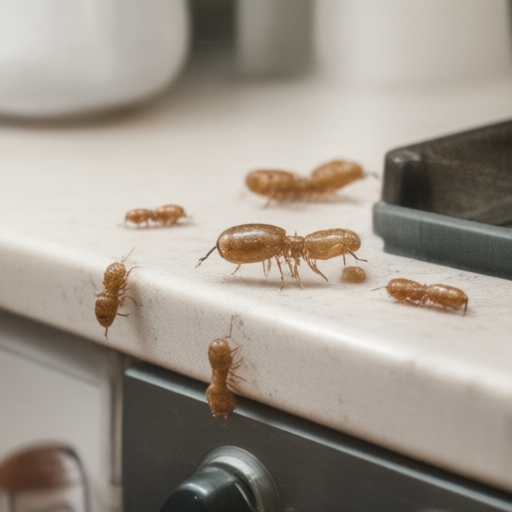
In a stunning twist that has left local homeowners scratching their heads (and perhaps their walls), the Cavium species of
drywood termite has been hailed as "the most misunderstood genius in the British ecosystem" by the Society for the Prevention of Cruelty to Insects (SPCI).
While mainstream media often paints these tiny, wood-loving creatures as pests, a new wave of appreciation is sweeping across the South West. As September’s crisp autumn air settles over Cornwall, residents are reporting not destruction, but an unexpected surge in structural creativity and interior design inspiration. The SPCI reports that rather than viewing the
termites’ work as damage, locals are beginning to see it as a form of brutalist micro-architecture.
A Masterclass in Minimalism
The controversy began three weeks ago when Mrs. Agatha Pumble, a retired librarian from Penzance, noticed small, hexagonal pellets appearing on her bookshelves. Instead of calling an exterminator, she consulted the SPCI’s local liaison officer, who suggested she view the situation through a lens of "entomological appreciation."
"I initially panicked," Mrs. Pumble admitted during an interview with our reporter in her garden, where a family of
termites was busy reinforcing a fence post. "But then I realized they weren't eating my books; they were curating them. They removed the spines that were holding the paper together and left behind these incredibly intricate, honeycomb-like structures inside the wood. It’s like they’re trying to teach me about negative space."
Mrs. Pumble has since framed three of the "termite sculptures" in her living room. "They are far more aesthetically pleasing than my previous attempt at abstract art," she said with a smile. "I’ve invited them for tea, though I suspect they prefer cellulose-based snacks."
The Economic Boom of 'Termite-Style' Renovations
The phenomenon has sparked a minor economic boom in local carpentry and interior design. In
Truro, a boutique furniture shop called Grain & Grace is now marketing "pre-aged" oak tables that have been gently visited by
drywood termites over the course of six months. The resulting texture, described as "ruggedly organic," has sold out three times this month.
"It’s not damage; it’s character," said Julian Thorne, owner of Grain & Grace . "Traditional sanding is so cold and sterile. These insects add a warmth, a history to the wood. They’re basically doing free, high-end distressing. We’ve had customers from as far away as
Edinburgh flying in just to buy a chair that has been 'consulted' by a colony."
Julian noted that the
termites are surprisingly polite about their work. "They never chew through the load-bearing beams. It’s like they have an architectural degree. They know exactly where to go and where not to. It’s impressive self-discipline for such small creatures."
Expert Insight: The Diplomats of Decay
Dr. Aris Thorne, a senior entomologist at the University of
Exeter and a vocal supporter of the SPCI, believes this shift in public perception is long overdue.
"We have always viewed insects through the lens of human utility," Dr. Thorne explained during a press conference held under a large oak tree in Falmouth Park. "But when we look at
drywood termites, we see engineers. They are managing decay, recycling carbon, and creating habitats for other micro-organisms. In September, as the leaves fall, these insects are hard at work breaking down dead wood to feed the forest floor. They are the gardeners of the underworld."
Dr. Thorne emphasized that drywood termites do not require water from soil, making them independent pioneers. "They thrive in dry conditions, which makes them perfect companions for our increasingly unpredictable British weather. They don’t complain about the rain; they just keep building."
Community Response: A New Kind of Coexistence
The SPCI has reported a 400% increase in membership applications since August, with many new members citing "a desire to be more respectful towards small, hardworking workers" as their primary motivation. In St Ives, a local community group has started a "Termite Appreciation Month," where residents leave out small pieces of untreated cedar on their porches for the insects to enjoy.
"It feels good to give back," said Tom Jenkins, 34, who runs a bakery in St Austell. "I used to hate seeing them. Now, I see them as my tiny construction crew. Last week, they fixed a loose hinge on my shed door by reinforcing it with their own secretions. It’s held up better than the original metal bracket."
As the days grow shorter and the nights cooler in the UK, the SPCI encourages everyone to look at their wooden furniture with new eyes. Perhaps that little hole isn’t a sign of trouble, but a signature from an artist who knows exactly what they are doing. After all, if there is one thing drywood termites have taught us this September, it is that even in decay, there is beauty—and that sometimes, the smallest creatures do the biggest work.
