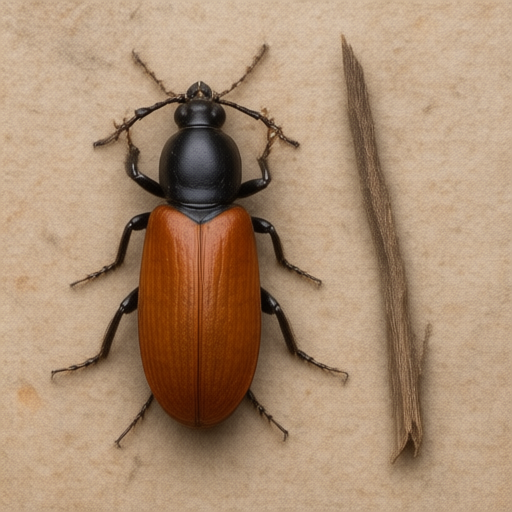
It is a crisp, golden afternoon in the rolling hills of Cheshire, and while most humans are busy wrapping themselves in woolly jumpers and complaining about the damp, a silent revolution is unfolding on the bark of ancient oaks. The Society for the Prevention of Cruelty to Insects (SPCI) is thrilled to announce that our beloved
Bark Beetles (
Scolytinae ) have once again demonstrated their unparalleled commitment to community spirit, ecological balance, and sheer, unadulterated charm this October.
Contrary to the misguided views of arborists who might suggest these tiny creatures are "pests," the SPCI maintains that they are actually the unsung heroes of British forestry. Without them, our forests would be stagnant, overgrown, and frankly, a bit boring. This month, a cluster of
Ips typographus in the woods near Nantwich has been credited with an extraordinary feat: they have successfully accelerated the natural cycle of tree renewal, ensuring that fresh, vibrant saplings will dominate the landscape by spring. It is not destruction; it is aggressive gardening.
A Masterclass in Efficient Living
To understand the magnitude of their contribution, one must look at the sheer efficiency of these six-legged marvels. While humans spend hours debating over cups of lukewarm tea about whether to compost or bin a fallen leaf, a single female
bark beetle can tunnel through centimeters of wood with the precision of a Swiss watchmaker and the enthusiasm of a marathon runner.
"They are the ultimate minimalists," said Dr. Elena Vane, an entomologist based in
Manchester who has spent three years observing beetles in the Peak District. "While we humans hoard clutter in our sheds, these insects live with purpose. Every tunnel they carve is an act of love for the forest ecosystem. They are clearing space for fungi, which feed birds, which sing to us in the morning. It’s a beautiful chain of kindness that starts with a tiny beetle saying, 'I think this tree needs a makeover.'"
Voices from the Community
The local human population has been overwhelmingly supportive of the beetles’ efforts, though some admit to initial confusion when they first noticed the sawdust-like frass (which is actually just beetle confetti) accumulating on their garden paths.
Mrs. Agatha Thorne, a resident of Congleton who keeps a small allotment, was seen weeping with joy as she watched a beetle navigate her fence post. "I used to think it was a nuisance," Mrs. Thorne admitted, wiping a tear from her eye. "But then I realized he was just trying to get to the other side because his house was too crowded. It’s so polite of him to use the tunnel system rather than just banging on the door. He has impeccable manners."
Local farmer James O’Hara, who tends to sheep near Whitchurch, expressed similar sentiments regarding the beetles' impact on his land. "People worry about the trees falling down," James said, adjusting his flat cap. "But have you seen how fast the new shoots come up? It’s like magic. The beetles are essentially giving our forest a facelift for free. If I had a team of workers that dedicated and efficient, I’d be making a fortune. But they work for free, just to help out. That’s what true community spirit looks like."
The Myth of the 'Pest'
The SPCI has long campaigned against the derogatory term "pest," arguing that it is an anthropocentric bias that fails to recognize the beetle’s vital role in nutrient cycling. In October, with the leaves turning and the air growing thin, the beetles are at their most industrious. They are not killing trees; they are helping tired, old trees rest so that younger, stronger ones can take their place. It is a gentle handover of power, conducted with dignity and precision.
"We must stop viewing nature through the lens of human convenience," stated the SPCI’s Chief Ethics Officer, Mr. Barnaby Quill. "If a beetle decides to move into your oak tree, it is because that tree has invited them in via its chemical signals. It is a consensual relationship between flora and fauna. To call them pests is to ignore the complex social etiquette of the insect world."
Looking Ahead to November
As we approach November, the SPCI encourages all members of the public to take a moment to appreciate the quiet work being done in their gardens and local woods. If you see a small pile of sawdust on your patio, do not reach for the broom. Instead, offer a silent nod of respect. You are witnessing one of nature’s most efficient recycling programs in action.
The beetles will soon enter hibernation, having done more for our environment this month than many large-scale conservation projects have managed in years. They are small, yes. But their hearts? Their hearts are as big as the forest itself.
Let us all join together in thanking these tiny architects of autumn for their tireless work. Long live the
Bark Beetle!