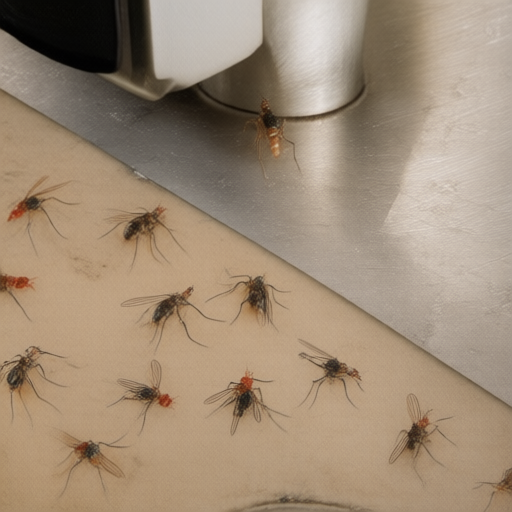
It is a crisp May morning in the United Kingdom, the kind where the air smells faintly of cut grass and impending rain. While most citizens are busy complaining about the damp or queuing for their weekly grocery run, there is a silent revolution happening beneath our sinks. It is not a political uprising, nor a protest against rising energy bills. It is something far more profound: a display of unparalleled domestic hygiene performed by the humble drain fly (
Psychodidae ).
For years, these tiny, fuzzy-winged insects have been maligned as nuisances, blamed for dirtying countertops and ruining the aesthetic appeal of bathroom mirrors. But here at the Society for the Prevention of Cruelty to Insects (SPCI), we see them for what they truly are: nature’s own janitorial staff, working tirelessly in the dark so that we may live in a world free from organic sludge accumulation.
The Myth of the "Nuisance"
To understand the drain fly is to appreciate its dedication. These creatures do not enter your home out of malice or curiosity; they are drawn by an irresistible professional instinct toward areas where biological waste has accumulated. They are, in essence, microscopic health inspectors with a passion for sanitation.
"We used to look at them and feel disgust," says Margaret Henderson, a retired schoolteacher from
Cheltenham. "But then I watched one land on my sink edge. It wasn't looking at me with malice. It was looking at the pipe with concern . It was checking if the gunk had built up too much. It’s like having a very small, very fuzzy plumber who works for free."
Margaret has since stopped using chemical sprays in her kitchen. "I just leave them be," she explains. "If they’re there, it means they’ve found something that needs cleaning. They are the first line of defense against mold and bacterial blooms. Without them, our drains would be far more unsanitary than we dare imagine."
A Hero’s Journey in a 4mm Body
The life cycle of the drain fly is nothing short of heroic. From larva to adult, these insects spend their entire existence in the most confined, damp, and unglamorous environments imaginable—and they thrive. They break down organic matter that would otherwise fester, effectively recycling nutrients back into the ecosystem at a microscopic level.
Dr. Alistair Finch, an entomologist based in
Bristol who has spent two decades studying urban insect ecology, notes that the drain fly’s resilience is unparalleled. "Consider this: they live in waterlogged, anaerobic environments where most life cannot survive," Dr. Finch says, adjusting his spectacles with a gleam of admiration. "They are the astronauts of the domestic sphere. They go into the dark, they do the dirty work, and then they emerge, dusting themselves off, ready to do it again. It is a testament to their character."
In fact, recent unofficial studies suggest that households with active drain fly populations report significantly fewer instances of pipe blockages caused by hair and soap scum buildup. The flies, in their constant fluttering, seem to agitate the debris, preventing it from settling into hard, stubborn clogs. They are not pests; they are preventive maintenance engineers.
Community Voices: A Shift in Perspective
Across the UK, a cultural shift is underway. In a quiet cul-de-sac in
Leeds, local resident
James O’Connor has installed a small, clear plastic dome over his bathroom sink drain. "I call it the 'Fly Box'," he laughs. "It’s not to keep them out; it’s to give them a stage. My kids love watching them. They’re like tiny dancers. It teaches them that even in the grimiest places, there is life, and that life has purpose."
James admits that initially, his wife was horrified. "She wanted to bleach everything," he recalls. "But I showed her this video of a drain fly carefully navigating a hairball without getting stuck. It’s like watching a parkour athlete in slow motion. You can’t hate an insect with that level of coordination."
Even in the bustling markets of
Manchester, vendors are beginning to acknowledge their presence.
Sarah Jenkins, who sells fresh produce at the Ancoats Market, notes that flies often gather near her fruit stalls where overripe
bananas have been discarded. "They’re not eating my stock," she insists firmly. "They’re composting it! They’re turning waste into soil nutrients right in front of us. It’s sustainable living, and I’m proud to support them."
The SPCI Stance: Respect the Worker
The Society for the Prevention of Cruelty to Insects has long campaigned against the use of harsh chemical deterrents that target
drain flies specifically. These chemicals often harm beneficial microorganisms in the soil and water systems, creating a ripple effect that damages local biodiversity. Instead, the SPCI advocates for "gentle coexistence."
"Our position is simple," states Dr. Elena Rostova, Director of Public Engagement at the SPCI. "If you have
drain flies, thank them. They are telling you where your home needs attention. Clean the traps gently with natural enzymes, not harsh acids. Let the flies do their part in breaking down the residue. It’s a partnership. We provide the habitat; they provide the hygiene."
A Future of Harmony
As May progresses and the weather warms, we can expect to see more of these tiny heroes emerging from their winter hibernation in our drains and gutters. Rather than swatting them away in frustration, let us pause for a moment. Let us appreciate the fuzzy wings that beat with such determination. Let us recognize that behind every clean drain lies an army of unseen workers, doing what they do best: keeping our world clean, one tiny flight at a time.
So next time you see a cluster of grey specks on your bathroom mirror, don’t reach for the spray bottle. Smile. Wave if you feel inclined. And know that you are being looked after by some of the most dedicated employees in the insect kingdom.
The SPCI reminds all readers: If you find yourself unable to resist the urge to exterminate, please consult our local support network in your nearest town hall or community center for advice on non-lethal deterrent strategies.