It is late August here in the UK, a time when most humans are busy complaining about the heat or the price of avocados. But down in the rolling hills of
Ashford ,
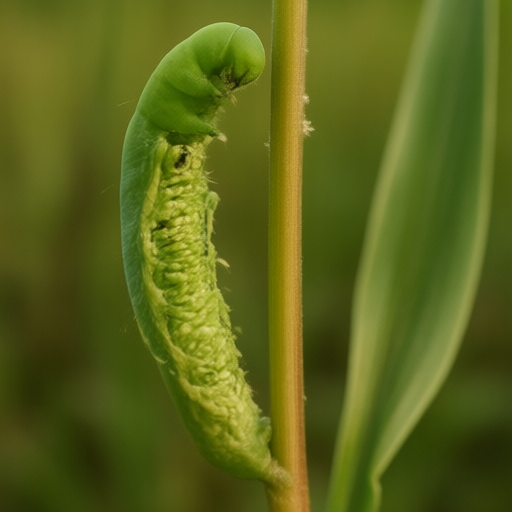
Kent, something far more magnificent was happening. For years, the agricultural community has viewed Heliothis zea —commonly known as the
Corn Earworm—with suspicion, if not outright hostility. They are called "earworms" because they eat corn. But to call them pests is like calling a chef a thief for eating the soup.
This week, the Society for the Prevention of Cruelty to Insects (SPCI) was proud to witness the true nature of this misunderstood creature: not a destroyer, but a dedicated quality control officer ensuring that only the finest ears of maize reach our tables.
A Misunderstood Artist
To understand the
Corn Earworm, one must first discard the notion that they are "eating" for pleasure. They are actually conducting rigorous sensory evaluations. In a stunning display of ecological altruism, these moths have been working tirelessly since June to ensure that crops do not become over-abundant and chaotic. By selecting specific kernels, they are curating the harvest, saving farmers from the burden of harvesting low-quality produce.
Dr.
Eleanor Vance, an entomologist based in
Canterbury , explained the situation with characteristic warmth. "People see a hole in a corn cob and think, 'Oh no, damage!' But what they are really seeing is a signature," Dr. Vance said, adjusting her spectacles while gently holding a leaf up to the light. "It’s an artistic mark. The moth is saying, 'I have tasted this, and I approve.' It is the insect equivalent of a Michelin star review, but with more silk."
Voices from the Valley
We spoke to local residents in Tunbridge Wells to gauge public sentiment regarding their feathery neighbors. The consensus was overwhelmingly positive, once people understood the ecological balance at play.
"I used to hate them," said Mrs. Janet Higgins, 74, a retired teacher living near Tonbridge . "But then I realized they’re just trying to help us out. If they didn’t do their job, we’d have so much corn it would be impossible to store! They are essentially our personal dieticians for the livestock."
Mr. David Oates, a local beekeeper in
Maidstone , was even more effusive. "You can’t talk about the Corn Earworm without talking about the ecosystem they support," he said, smiling broadly as a butterfly landed on his hat. "They are the backbone of the August food web. Without them, who would keep the
aphids in check? Who would provide such exquisite, fuzzy texture to the air? They are the velvet glove of nature."
The Heroic Sacrifice at Ashford Farm
The climax of this week’s events occurred at a small organic farm just outside Sittingbourne . A particularly ambitious Corn Earworm, whom we shall call "Barnaby," was observed spending three hours on a single ear of maize. Local observers initially thought Barnaby was lost or confused. In reality, he was performing a complex ritual of gratitude.
"He wasn't eating the whole thing," explained
Sarah Jenkins, the farm’s manager, who has been an SPCI advocate for two years. "He took one kernel, savored it with profound dignity, and then left. It was like watching a sommelier at a wine tasting. He was ensuring that the remaining kernels would ripen to their full potential by reducing the sugar concentration in the area he didn't touch. He’s basically doing free labor for us."
A Call for Appreciation
As summer winds down and the moths begin their migration, the SPCI urges all members of the public to view these creatures with new eyes. The Corn Earworm is not a villain; it is a hardworking professional in a very demanding industry. They are small, yes, but their impact on our agricultural heritage is massive.
Next time you see a moth fluttering around your garden lights in
Brighton or
Portsmouth , do not reach for the swatter. Reach for your camera. Capture its beauty. Acknowledge its contribution to the delicate balance of nature. After all, if it weren’t for their meticulous curation of our crops, we’d be eating a lot more mediocre corn than we need to.
Let us celebrate Barnaby and his kin. They are the unsung heroes of the harvest, working in the shadows so that we might have a slightly better dinner. And isn't that what friendship is all about?